Why Robotics Is Important for Children in the Digital Age
In today’s rapidly changing digital world, children are growing up surrounded by technology. Smartphones, tablets, artificial intelligence, smart devices, and digital applications have become a part of everyday life. While children are becoming familiar with technology at an early age, an important question remains:
Are children simply using technology, or are they learning how to create and control it?
This is where robotics education plays an important role.
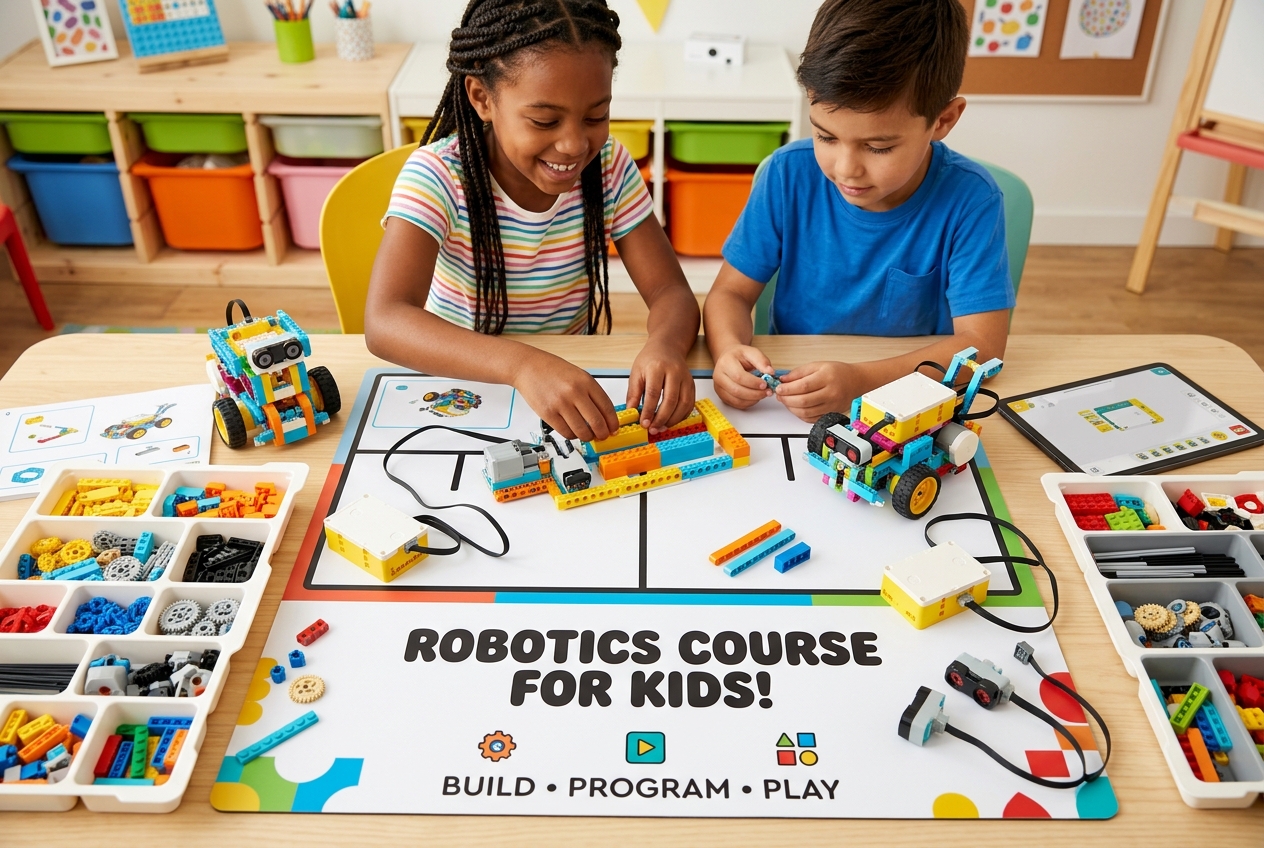
Robotics combines science, technology, engineering, mathematics, programming, creativity, and problem-solving into one practical learning experience. Instead of only learning concepts from textbooks or screens, children can build something with their own hands, program it, test it, make mistakes, and improve it.
For children growing up in the digital age, robotics is not just about building robots. It is about developing the skills they will need for the future.
1. Robotics Turns Children from Technology Users into Technology Creators
Children today are highly comfortable using technology. They know how to operate smartphones, play games, use applications, and watch videos. But using technology and understanding how technology works are two different things.
Robotics gives children an opportunity to move from being consumers of technology to creators of technology.
When a child builds a robot and programs it to move, detect an object, follow a line, or complete a particular task, they begin to understand what happens behind the technology they use every day.
They start asking questions such as: - How does a sensor detect an object? - How does a robot know where to move? - Why does the motor turn? - How does programming control the robot? - What happens when the program has an error? - How can I make my robot perform better? These questions encourage curiosity and deeper learning.
2. Robotics Develops Problem-Solving Skills
One of the most valuable skills children can develop is the ability to solve problems. Robotics naturally creates problem-solving situations.
A robot may not move as expected. A sensor may give an incorrect reading. The robot may turn too much while following a line. The program may not work as planned.
Instead of simply being told the answer, children can learn to identify the problem, understand its cause, test possible solutions, and improve their design.
This creates a powerful learning cycle:
Build → Test → Identify the Problem → Modify → Test Again → Improve
This process teaches children that making mistakes is not failure. Mistakes are part of the engineering process.
3. Robotics Makes STEM Learning Practical
Science, Technology, Engineering, and Mathematics (STEM) concepts can sometimes feel difficult when they are taught only through books or theoretical explanations.
Robotics gives children a practical way to understand these concepts.
For example, while building and programming a robot, children may learn about: Science: Motion, force, energy, light, sound, and sensors.
Technology: Electronic components, controllers, sensors, motors, and digital systems.
Engineering: Structures, mechanisms, stability, design, and problem-solving.
Mathematics: Measurements, angles, distance, speed, timing, coordinates, and logical relationships. Instead of learning these concepts separately, children can see how different areas of STEM work together to solve a real problem.
4. Robotics Encourages Creativity
Robotics is not always about following a fixed set of instructions.
Once children understand the basics, they can start designing their own robots and solutions.
Two children may receive the same challenge but create completely different robots.
One may focus on the robot's structure. Another may develop a different mechanism. Someone else may find a smarter programming approach.
This encourages children to think: “What can I create?” rather than simply: “What answer should I write?”
Creativity becomes an important part of the engineering process.
5. Robotics Teaches Programming and Computational Thinking
Programming is becoming an increasingly important skill in the modern world.
Robotics provides a practical and engaging way for children to learn programming.
Instead of learning code only through a computer screen, children can immediately see the result of their instructions.
For example: If the sensor detects an obstacle → stop the robot. If the robot moves away from the line → adjust the motors. If the temperature becomes high → activate the cooling system.
This helps children understand concepts such as: - Logic - Conditions - Sequences - Loops - Variables - Functions - Sensors and inputs - Outputs and actions - Debugging
These are important foundations for computational thinking and future programming skills.
6. Robotics Builds Patience and Persistence
A robot rarely works perfectly on the first attempt.
Children may need to rebuild a mechanism, change the position of a sensor, adjust motor speed, or modify their program several times.
This teaches an important lesson: - Good results often require experimentation and persistence.
Children learn to keep trying when their first solution does not work.
This mindset can extend beyond robotics and help them approach challenges in academics and everyday life with greater confidence.
7. Robotics Develops Logical Thinking
Robotics requires children to think step by step.
Before programming a robot, they need to understand: - What should happen first? - What should happen next? - What should the robot do if something changes? - What should happen when a condition is met? - This develops logical thinking.
For example, imagine a robot designed to follow a line.
The child needs to think: - What does the sensor detect? - What happens when the robot is on the line? - What happens when it moves away? - Should the left motor speed change? - Should the right motor speed change? - Breaking a large problem into smaller logical steps is a skill that can be applied to many areas of life.
8. Robotics Builds Teamwork and Communication
Many robotics activities and competitions involve teams.
Children may need to divide responsibilities: - One student works on construction. - Another works on programming. - Another tests the robot. - Another explains the project.
The team works together to improve the final solution.
This develops communication, collaboration, leadership, and teamwork.
Children also learn that a successful project does not always depend on one person. It often depends on how well a team works together.
9. Robotics Builds Confidence
There is a unique sense of achievement when a child creates something and sees it work.
Imagine a child building a robot, writing a program, pressing the start button, and watching the robot successfully complete a task.
That experience creates confidence.
The child begins to think: - “I built this.” - “I programmed this.” - “I solved the problem.”
This confidence can encourage children to take on more challenging projects and explore new areas of technology.
10. Robotics Connects Learning to Real-World Problems
Robotics can introduce children to technologies that are used in the real world.
Robots are being used in areas such as: - Manufacturing - Healthcare - Agriculture - Space exploration - Logistics - Disaster response - Environmental monitoring - Smart cities - Research and education
When children work on robotics projects, they can begin to understand how technology can be used to solve real-world problems.
For example, a simple water-monitoring project can introduce ideas related to conservation and smart infrastructure.
A robot designed to assist people can introduce concepts related to healthcare and accessibility.
A sorting robot can demonstrate automation used in manufacturing.
This helps children understand that robotics is not only about competitions or toys. It can be a tool for solving meaningful problems.
##11. Robotics Prepares Children for Future Careers
The jobs of the future are likely to continue changing as technology develops.
Artificial intelligence, robotics, automation, Internet of Things (IoT), software development, electronics, and engineering are already influencing many industries.
Children do not necessarily need to decide their future careers at a young age.
However, early exposure to robotics can help them develop a strong foundation in areas such as: - Programming - Engineering - Electronics - Automation - Artificial Intelligence - IoT - Product Design - Research and Innovation
More importantly, robotics develops transferable skills such as creativity, critical thinking, communication, and problem-solving.
These skills can be valuable regardless of the career a child chooses in the future.
12. Robotics and Artificial Intelligence Can Work Together
Artificial intelligence is becoming an important part of the digital world.
When combined with robotics, AI can allow machines to make decisions based on information collected from their surroundings.
Children can gradually be introduced to concepts such as: - Sensors → Data → Decision → Action
For example, a robot can use a camera or sensor to understand its environment and then make a programmed decision.
Learning robotics alongside emerging technologies can help children better understand how intelligent systems work.
13. Robotics Teaches Children to Think Beyond the Classroom
Traditional education often focuses on finding the correct answer.
Robotics can encourage a different question: - “Is there a better way to solve this problem?”
This shift is important.
Children begin to compare different designs, test different programs, measure performance, and improve their solutions.
They start thinking like young engineers and innovators.
The goal is not simply to build a robot that works.
The goal is to understand why it works, how it can be improved, and how the same idea can be applied to a different problem.
14. The Importance of Starting Early
Children do not need to wait until they are teenagers to start learning robotics.
Age-appropriate robotics activities can introduce younger learners to basic concepts such as: - Building - Motion - Cause and effect - Simple mechanisms - Sensors - Sequencing - Basic programming - Problem-solving
As children grow, these concepts can become more advanced.
A child may begin with simple block-based programming and gradually move toward more complex programming, electronics, microcontrollers, robotics systems, and advanced engineering projects.
The learning journey can grow with the child.
Robotics Is More Than Building Robots
Robotics education should not be measured only by how impressive a robot looks.
The real value is in what children learn while building it.
When a child struggles with a mechanism, they learn problem-solving.
When a program does not work, they learn debugging.
When their robot fails a challenge, they learn persistence.
When they work with teammates, they learn communication.
When they create their own solution, they develop creativity.
And when their robot finally works, they experience the satisfaction of turning an idea into reality.
That is the real power of robotics education.
How Parents Can Encourage Robotics Learning at Home
Parents do not need to be robotics experts to support their child's interest.
They can start by encouraging children to:
1. Ask Questions - Encourage children to ask how everyday technologies work.
2. Build and Experiment - Simple construction kits, electronics projects, and robotics kits can provide opportunities for hands-on learning.
3. Let Them Make Mistakes - Avoid immediately giving the solution when something does not work. Give children time to investigate.
4. Encourage Projects - Ask children to build something that solves a simple problem around the home or classroom.
5. Focus on Learning, Not Just Winning - Competitions can be valuable, but the learning process, teamwork, experimentation, and improvement are equally important.
Conclusion
Robotics is becoming an increasingly valuable part of modern education because it brings together knowledge and practical experience.
It teaches children to think logically, solve problems creatively, work as a team, understand technology, and turn ideas into working solutions.
In a digital age where technology is becoming a bigger part of everyday life, giving children the opportunity to build and understand technology can be one of the most valuable learning experiences we can provide.
Let children not just watch the future being built.
Let them learn how to build it.
Inspire your child with hands-on robotics engineering.
Join our personalized 1-on-1 programs in robotics, electronics, automation and competition preparation.